The Torah portion that is read this week in the Jewish Diaspora contains a number of disparate bits and bobs. There’s a census. Then a list of which families of Levites have the job of packing and shlepping the tabernacle from place to place. Then some disturbing practices around suspected adultery which we will leave for another day.
And then come a series of commandments related to the Nazirites – a caste of individuals in Israelite history who swear an oath of devotion to God. And for the duration of their oath, they don’t drink alcohol or cut their hair. Sound familiar?
Yes, the most famous abstainer from wine and grower of hair is, of course, the biblical figure of Samson. And in fact this weekend’s haftarah portion, the companion text for this bit of Torah, is the tale of Samson’s miraculous birth. (Judges 13:2-24)
This is a curious and cinematic story that I’m surprised doesn’t get more play. Like the birth of heroes and saviors across cultures, Samson’s birth is prophesied and divinely declared. Like in the stories of the matriarch Sarah in Genesis and of Mary in the New Testament, a woman who is unable to conceive a child either physically or socially is visited by an angel who announces that a child is on its way.
And so it happens in this story. At the center is a woman who is unnamed through the entire account. Our later midrashic tradition, which abhors a vacuum, supplies a name from elsewhere in Torah: Hatzlelponi, which I’m sure sounded better back in the day. (Bamidbar Rabbah 10:5). A stranger, identified in the text as an angel or messenger of Adonai (because angel and messenger are the same word in Hebrew) arrives and tells her that she will give birth to a great hero who will deliver Israel from the Philistines, and that during her pregnancy she should neither drink alcohol nor cut her hair.
She goes to her husband (who is named in the text but, for a change of pace, let’s leave him anonymous). She tells him about the encounter. He accepts the prophecy but doesn’t quite buy the angel bit. He prays for the visitor to return to explain how they should raise a miracle child. And sure enough the next day the angel is back.
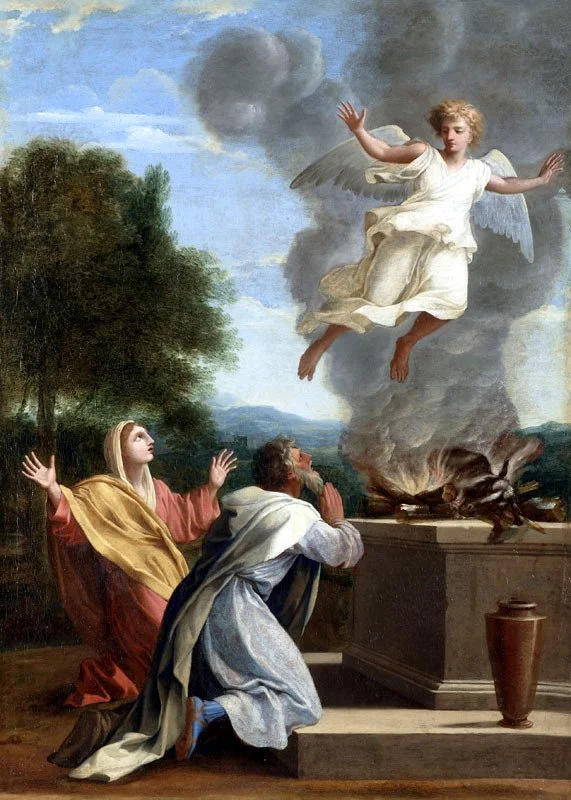
Hatzlelponi fetches her husband and he interrogates the stranger. What do we do? What do we do? The angel repeats to him what it had already said directly to her the first time. Wine. Hair. The husband offers the stranger a meal, which the stranger declines. Instead, says the stranger, make an offering to God, which they do. And the angel then flies up to heaven on the flames of the offering.
And thus ends this particular angelic encounter.
I love angel stories, of course. The fun of the magical. Divine interventions and engagements. Jewish tradition is full of them. Our medieval texts contain lists and lists of angels and their specific spheres of authority. And more people than I can count have confided in me some experience that felt to them angelic in some way.
Talmud relates that at every moment, each blade of grass has an angel hitting it with a stick, saying, grow, grow! If this is so, and were angels beings that took up physical space, they would not be able to fit in this dimension!
The great Medieval rationalist Maimonides solved this out in his Guide for the Perplexed, saying that angels are utterly incorporeal; that they appear sometimes as male and sometimes as female, sometimes as angels, sometimes as spirits. But they have no bodily form outside of the mind of the person perceiving them.
I like pairing these two insights. Angels are everywhere! And – it’s all in your head.
Combined, these insights capture something meaningful. That perhaps there is something that flows through all of us, some greater consciousness that we are part of, always present, but usually beyond our ordinary senses. When we do access it, we give it form, using our imaginal faculties and our particular cultural symbolisms. When we tap into the ongoing hubbub of consciousness, that wants to be tapped into and roots for us and our expanded minds, that whacks us with a stick to say, people – grow, grow! – when we tap into this we give it form, sometimes scary and sometimes dazzlingly beautiful, and sometimes it just looks like a stranger – and sometimes it looks like the person sitting next to you right now. Because sometimes we are the ones inspired to do the angelic work.
And what is that work? It might not be prophesying a physical birth, which sounds like a dicey job. But it might be sharing the awareness that there is something new ahead – something waiting to be birthed into the world, some transformation, some evolution that can come into being, that is even now coming into being. Even in times that feel so sad. Even when things are crumbling. All is not lost. The new is being born and we can have a hand in that if our attention is drawn properly to it.
So back to our story. Before the angel’s dramatic exit up the plume of flame, the husband asks it, “What is your name, so we can honor you?”
The angel responds, “Why do you ask? My name is wondrous! Shmi peli. My name is wondrous.
A rather evasive answer, no? Are angels always this coy? The one that wrestled Jacob also refused to identify itself. Some commentators say it’s not evasive at all. That Peli, meaning “wondrous”, is in fact the angel’s name. How do you do? I’m Wondrous. But other sages say the angel declines to answer because angels’ names are not fixed. That an angel’s mission is its name. And thus its name is always changing, depending on its task.
And so, angels, now I ask you. Take a moment. Take a breath. What is your task right now? In this moment of the world, in this moment of your life? Take a moment to notice.
What is your task?
And angel, what is your name?
How wondrous is that?
