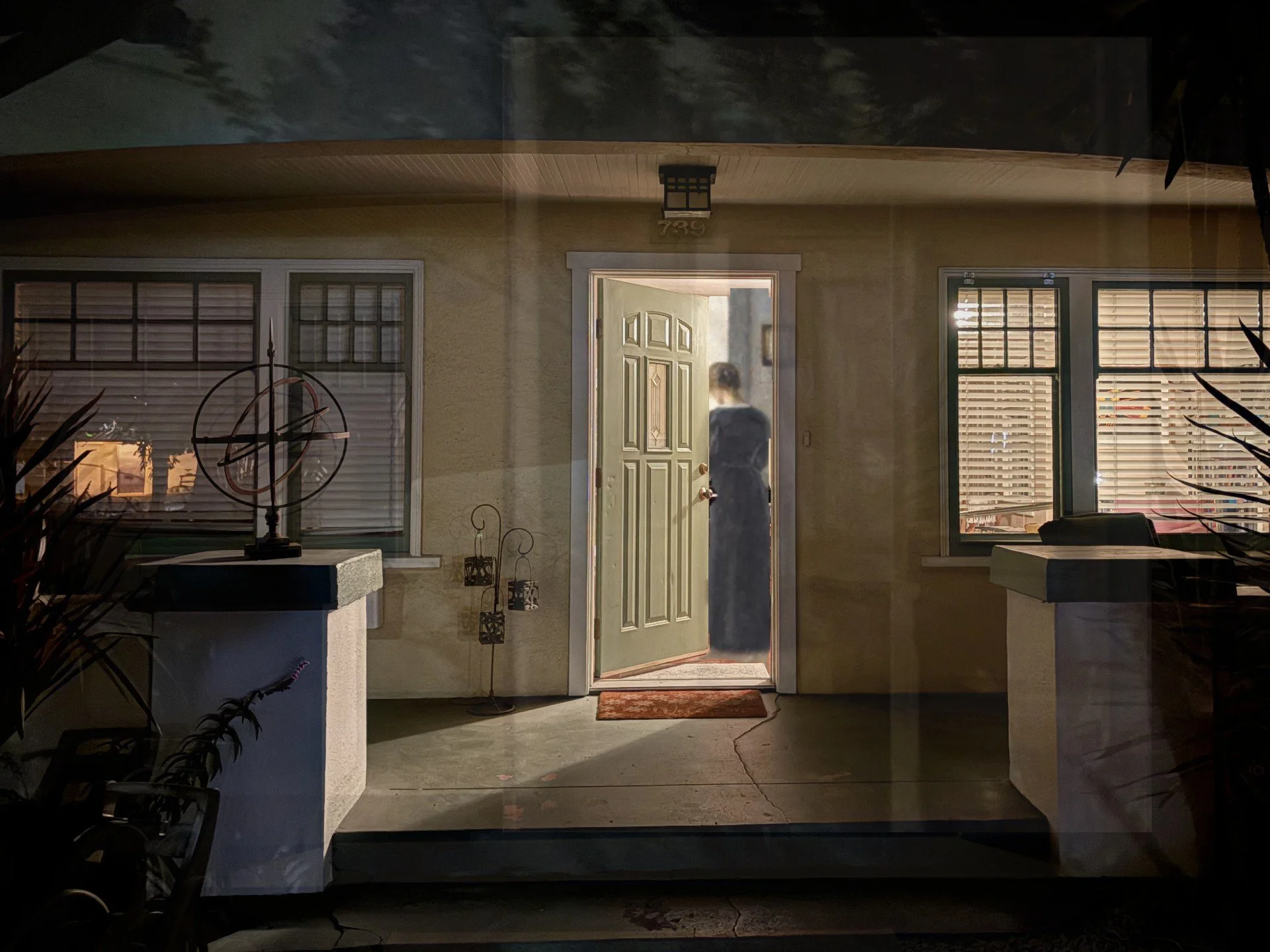
This week, four weeks into our annual cycle of Torah reading, we arrive at a portion of the Book of Genesis, called Vayera. Which, a propos of nothing, happens to have been my bar mitzvah portion more than a half century ago.
It opens on a hot day, with Abraham sitting in the shade of the ancient trees of Mamre. Right there God appears to him. Not in a burning bush or a smouldering mountain or a parting sea. None of those things. God appears in the form of three figures. Abraham just looks up and there they are.
These figures are referred to initially as anashim, or “people” but later in the portion they are identified as malakhim, or “angels”. This text is one of the reasons that our sages of old suspected all unnamed “people” in Torah to be angels.
But even though we the readers know from the first word of the portion that this is some kind of epiphany, we don’t know what Abraham knows. As far as he is concerned, they are simple human travelers. Nonetheless, he treats them as if they were Divine. He runs toward them and bows to the ground. He addresses them as “my lords,” which in Hebrew is adonay, the same word that we substitute for God’s unutterable name when we are speaking. Adonay, he says, please stop and let me bring water so you can bathe your feet and recline under the tree. And let me fetch food for you to refresh yourselves. And then he and Sarah make it so.
Abraham’s unhesitating response to the appearance of the strangers, his generosity, his busy industry in making sure they are taken care of – this is held as the model of hospitality in Jewish tradition. It is still the model of hospitality in many cultures in the world. Less so in ours. At my house in Santa Rosa I like to sit on the front porch, after having spent 19 years living off the beaten track with neither porch nor passersby. I like to sit and say hello to anyone strolling past with whom I happen to make eye contact (and I confess I usually try to engineer eye contact). Sometimes there’s a little small talk about the flowers in the yard or the weather or the upcoming election. Every once in a while a Ner Shalom congregant will bicycle by, not having realized where I live, and we will stand on the sidewalk or on the street and talk for a while about the neighborhood and synagogue things.
But in none of these cases have I yet bowed to the ground. In none of these cases have I called passersby either adonai or “my lords”, although “sir” and “ma’am” have escaped my lips. I have not invited anyone to sit on the porch with me to rest in the shade, nor offered food beyond the annual Halloween candy.
My hospitality, at least my hospitality toward strangers, is meager. I am influenced by our American culture of independence which is a kind of stinginess – t hat what I have is mine; it is not for neighbors; and certainly not for strangers. If I offer something, it is a favor, or it is charity. It is a noteworthy act of generosity that deviates from the natural course of things.
But for Abraham, our mythic ancestor, generosity is the natural course of things. It is simply what one does, how one lives on this earth. Strangers appear – you bow down, bring water, initiate the preparation of a feast. After the feast you don’t just say goodbye, you accompany your guests to get them safely back on the road. You treat them like royalty, or maybe like divinity. Abraham might not have known that his guests were angels, but he knew they could be. Every stranger could be an angel in disguise, including the people on my street whom I greet but don’t invite in for a meal.
Maybe it was just a different time, a mythic time, a time that never existed, back there on the plains of Mamre, in the shade of the terebinths. Abraham, whose name translates to something like Big Daddy, and Sarah, whose name translates to something like Great Queen – they weren’t real; they are archetypes. Or just the early humans of legend; and, as in other mythologies, the early humans from whom we poor shlubs descend are accustomed to moving among the gods, never knowing when those gods will be disguised and when they will be revealed. Anyone wandering up the path could be Divine, and this would have been an unremarkable piece of living in a remarkable era.
Maybe we need an infusion of this kind of hospitality now. Hospitality that is automatic and effusive and devotional. Because we are living in an era in which people are uprooted; many don’t have home or shelter; others are driven out of their countries by climate or politics. And climate and politics will keep changing; and humans will keep arriving in places that seem to have resources – food and shelter, water and work. As my friend and teacher Adam Horowitz teaches:
As fires rage, as waters run dry, as species and languages go extinct, as hundreds of millions of people are displaced by climate chaos, we must deepen our collective capacity for sacred hospitality . . . literally opening doors, filling plates, offering hope, care, and refuge.
Adam goes on to suggest that sacred hospitality demands not only material support but spiritual gifts too. He says:
It also means holding and hosting space for the sacred — turning our hearts toward the divine life and mystery in our midst. This world is clamoring for both. And the more we practice each, the more we realize they’re one and the same. . . .
[W]e need covenantal cadres, interspiritual orders, activist sanghas, and other refugia communities offering social, spiritual, and political home for young folks — and for anyone who knows what time it is and feels called to another way of life.
(“Toward an Infrastructure of Sacred Hospitality”)
Enso Village is in some ways such a place, specifically working against the current of isolation that so often traps elders. It is a kind of refuge space for people at a certain point in their lives, with a certain set of values, and a commitment to mutual care. We see similar values in co-housing developments, and in communities such as LandWell in Sebastopol that bills itself as “a wayfinding place for regenerative living, cultural renewal, and community resilience.” Many more such experiments are in the works.
The years ahead will be a test of our hospitality – how we find ways to welcome the stranger and keep them safe. And how we find ways to welcome each other and build communities of resilience. A test of how we step outside our comfort zones and open our doors to all who need it. And that we hold such acts as a spiritual imperative. Any one of us could be an angel. Each one of us is an angel.
Just one more quick idea about the psychospiritual place of hospitality in our lives. The medieval Persian poet Rumi, in his poem, “The Guest House,” suggests that we ourselves are houses and at our doorstep show up joys and sorrows, generosities and fears. All the parts of us arrive at the door, asking for entry. Rumi suggests that in the same way we should admit guests without judgment, so we should greet these parts of ourselves. He seems to know, as we all do, that the parts of us we are ashamed of are not easily turned away at the door.
So facing the needs of our fellow humans, we are instructed to open the door. And when facing all the parts of ourselves, we are reminded to open that door as well – to be gracious to ourselves so that we can be more readily gracious to others; to see the Divine in ourselves and then see the Divine in others. Our fears and sorrows might not look like angels from a Hallmark Christmas card, but they are sourced in the Divine like every other bit of us. Where else is there for them to come from? And if so, who are we to shut the door in their faces?
Vayera. Every visit, every visitor – an epiphany. Every human worthy of our care. Every part of ourselves, ditto.
The Guest House
This being human is a guest house.
Every morning a new arrival.
A joy, a depression, a meanness,
some momentary awareness comes
as an unexpected visitor.
Welcome and entertain them all!
Even if they’re a crowd of sorrows,
who violently sweep your house
empty of its furniture,
still, treat each guest honorably.
He may be clearing you out
for some new delight.
The dark thought, the shame, the malice,
meet them at the door laughing,
and invite them in.
Be grateful for whoever comes,
because each has been sent
as a guide from beyond.
(Jalaluddin Rumi, Translated by Coleman Barks)
