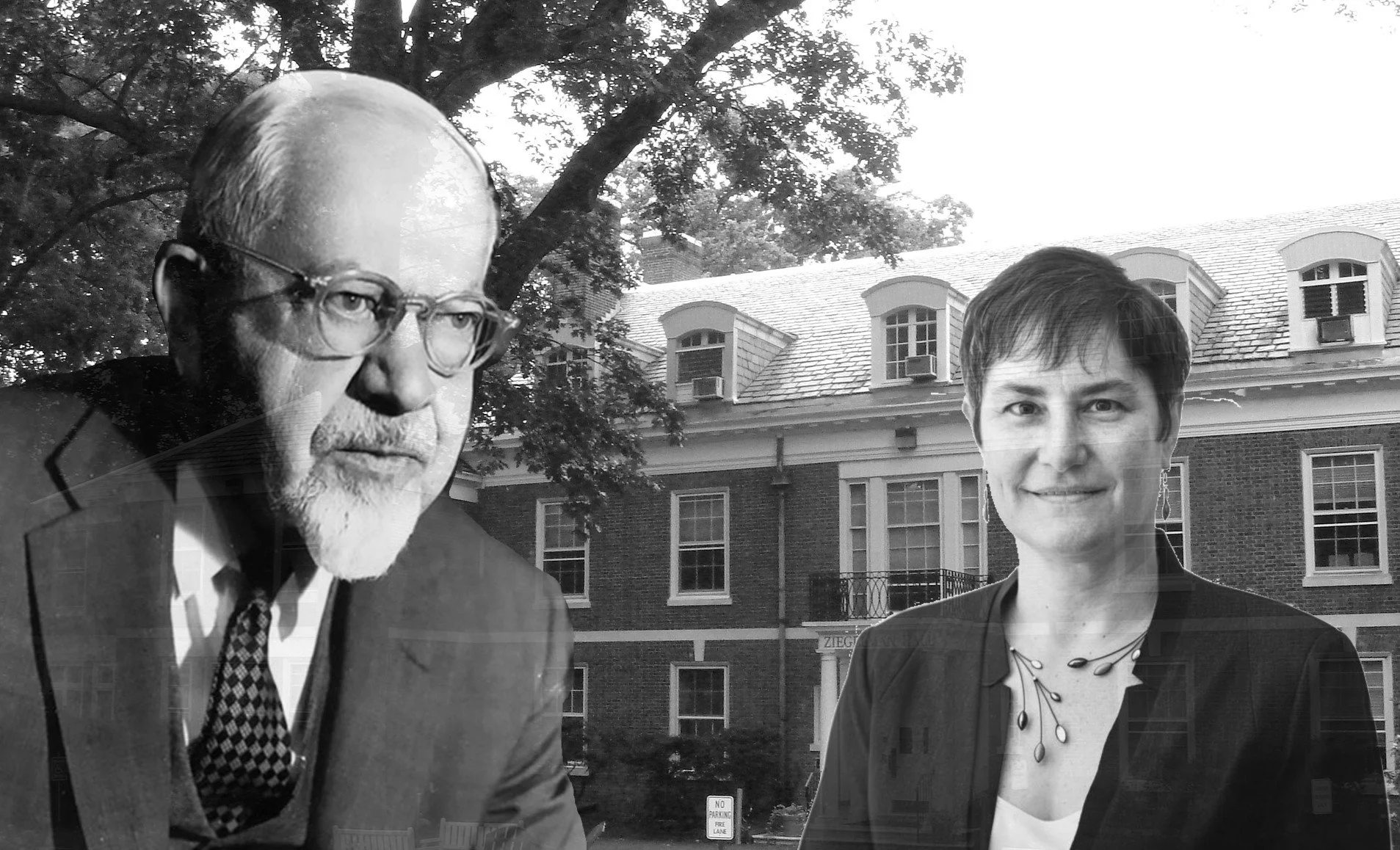
It’s been 5 days now, but I still feel freshly back from Philadelphia, where Susan and Shari and I made holy pilgrimage to the Reconstructing Judaism Convention. For several days before that I attended the biennial gathering of the Reconstructionist Rabbinical Association, of which I am a member.
I had not been excited about going. I know when I say, “Reconstructionist Rabbinical Association,” you think, “But that’s so exciting, how could you not have been excited about it?” But I had been in Israel for a month over the winter when my father-in-law died and I was kind of done with travel. Also, in this really divisive climate I have felt rather isolated, not among you, but among rabbis, I didn’t know what it would be like to be in a rabbinical scene.
Spoiler: it was good. These Reconstructionist rabbis are solid. They are solidly to the left, they are smart and erudite, they hold their criticisms of Israel alongside a deep commitment to the welfare of all our people.
I’m going to give you some tidbits about the Reconstructionist convention because we are, after all, a Reconstructionist congregation, which means you are all, more or less, Reconstructionists, and I’d love for that to mean something to you. I know that when I joined Ner Shalom 20 years ago it meant nothing to me. But now I feel proud that we are part of this particular lineage that began with the thought and practice of theologian, philosopher, and rabbi, Mordecai Kaplan. Kaplan remains a towering figure, and not only at the convention. Just this week the Forward ran an article about Kaplan calling him the revitalizer of 20th Century Judaism. They also refer to him as “forgotten.” Well, not forgotten by Reconstructionists certainly, even though Reconstructionism itself seems to have been forgotten by the journalist writing the article.
Mordecai Kaplan was a Big Idea Guy. Many of his thoughts might seem obvious to us now, but they weren’t when he first articulated them. He rejected an anthropomorphic God and located the Divine in our collective actions and relationships. He saw Judaism as an unfolding civilization beyond religion itself, and was committed to the nurturing of a Jewish peoplehood. He rejected triumphalism and chauvinism, including the idea of Jewish chosenness. He was an egalitarian and famously gave his daughter, Judith Kaplan Eisenstein, the first bat mitzvah on record, back in 1922.
This convention was the kind of scene where people bandy about the term “Kaplanian” and I got to do some Kaplanian learning myself. I attended a session where I learned that because of Kaplan’s opposition to concentrating religious authority in particular individuals, Reconstructionist rabbis are not “ordained” in the traditional sense. There is no semikhah, no laying of hands, to pass special authority on to them. So my colleagues who became rabbis in the Reconstructionist Rabbinical College simply graduated, and were given the title “rabbi” in recognition of having fulfilled all their course requirements. Who knew?
I attended another session on Kaplan’s Zionism. He believed Jews should be a nation in every sense, and that in this modern world that includes an autonomous state. But he saw that state as limited – a small, autonomous homeland in Palestine that would reinforce and reinvigorate Jewish peoplehood around the world. Not a homeland that all Jewish people should aspire to join. And that that homeland would be part of a larger body, for instance an Arab Federation. His Zionism also came with cautions. Any Jewish nation-state, in his view, would have to be guided by powerful ethical principles. In his 1934 tome, Judaism as a Civilization, he says, “When not disciplined and brought under the control of a moral standard such as represented by the Torah of Israel, nationhood is sure to run amuck, and, driven by the wild impulses of greed and vanity, is bound to wreak ruin upon all who come in its path.” So let’s consider Kaplan not only a philosopher but, alas, a prophet.
What other Kaplanalia for you? I heard a story that when asked to comment on whether Jews should celebrate a second day of holidays such as Rosh Hashanah and Shavuot, he responded that to do so is “like trying to dry yourself off with a wet towel.” Meaning the work has been done and a second day would simply be an unsatisfying use of yesterday’s tools. Later in his life he walked this back, I understand, saying that if people find it meaningful, of course they should do it.
Oh – and Kaplan’s nearly-90 year old granddaughter, Mim Eisenstein, the daughter of Judith Kaplan Eisenstein, the aforementioned first bat mitzvah, was also at the convention, along with her wife. I noticed whenever she was in the room, but was too shy to introduce myself. In any event, better to free up her time for the rabbis who actually “graduated” from the Reconstructionist seminary, whose investment in her grandfather is deeper and longer-standing than mine.
What else? I should say that Ner Shalom got some noteworthy attention at the convention. We have been growing as you all know, and flourishing, and other communities are interested in figuring out what we’re doing right (as are we). Our president, Susan Levine, who is also on the Reconstructing Judaism Board of Governors, was in her element. Beyond her tireless hobnobbing, she gave a workshop about the new dues structure that we adopted last year, and also sat on a panel about disability accommodation to speak about our Scent-Free Policy.
I also helped on the Ner Shalom visibility front. I led a healing service, a sort of soul massage of music and visualization, which, as it turned out, I needed as much as everyone else attending. I also got to participate in a havdalah concert of music written by rabbis and students in the movement. Among the offerings was the Ashirah Ladonai that I wrote a few years ago, and what a treat it was to hear it performed by such a group of talented musicians. Of course you all are no slouches either.
There were many interesting words and ideas shared at workshops and plenaries. About how Jewish safety increasingly gets falsely pitted against democracy. About the need for community even when we disagree about Israel. About Israeli-Palestinian peace and cooperation initiatives that aren’t sensational enough to make it onto the news but continue to operate steadfastly. And a joke one presenter made about using our birth Torah portions or our B.Mitzvah portions as a method of prognosticating what our role in activism will one day be. (Another spoiler: my bar mitzvah portion was Abraham arguing with God over the fate of Sodom. Sound right?)
Mostly the week was an opportunity to feel some peoplehood again, which hasn’t been easy during these past few raw and divisive years. I felt it in prayer. I felt it in song. I felt it being with over 100 rabbis who joined the weekly interfaith vigil outside Philadelphia’s ICE detention center. I felt it in the super rabbinical students I met. And in the queer affinity group I attended. I felt it going to a Rabbis for Ceasefire Happy Hour, not usually associating that group, founded early in the Gaza War, with the word “happy.” But give fierce clergy activists a margarita and you’ve got a party.
I felt peoplehood as we offered tributes to Reconstructing Judaism’s President, Rabbi Deborah Waxman, whom many of you have met on her visits to Ner Shalom, on the eve of her retirement. And I felt proud and grateful to have truly become part of the Reconstructionist world during what is already known as the Waxman Era.
The Torah portion we read all week was about the building of the mishkan, and how the entire community was invited to give according to their heart’s generosity. I felt that generosity of spirit around me, and that creativity. Divine, human, creative, generative peoplehood.
It was good to be there. I wish you had all been there with us. We carried you in our hearts and in our words as we thought about our beloved Ner Shalom, which is, to be completely chauvinist about it, unfolding Jewish civilization at its best.
Audio version includes a performance of Ashirah Ladonai.
