[Scroll Down for a New Song]
This Shabbat is Shabbat Hagadol – translating roughly as the Great Sabbath. Big Shabbos. Very exciting, all the greatness and bigness of it, you’d think. And yet no one knows why it’s called this. Some say it’s that in Torah, on the 10th of Nisan, when the Israelites were told to go get a lamb which would be sacrificed a few days later on the eve of the Exodus, it happened to have been Shabbat. And the Shabbat before Pesach is always the closest to the 10th of Nisan. And in fact, tonight it is actually the 10th of Nisan. Shabbat, the 10th of Nisan, just like it was when we were leaving Egypt. That is exciting, but I’m not sure that makes it “big”. If that were the reason, I probably would’ve called it The Lamb Shabbat. Or the Exodus Shabbat. Or something a little more descriptive.
Others say it is because of the haftarah we read tomorrow from the end of the Book of Malachi. In the closing of this short prophetic book, God describes the yom Adonai hagadol v’hanora – the Great and Terrible Day of Adonai, which God is preparing. A day of judgment, the end of the world as we know it, and the ushering in of a Messianic era.
This also makes sense grammatically, because if we were really talking about a “great Sabbath,” knowing that Shabbat is a feminine noun in Hebrew, it would have to be HaShabbat Hag’dolah. Instead, for geeky reasons, Shabbat Hagadol must mean something more like “the Shabbat of the Great Thing” of “Great Day” or something great. The Shabbat on which we imagine the Great Day that is coming.
As is often the case in our prophetic books, there is much reprimand directed at the Israelites. Terrible judgment will come if they don’t follow the commandments, if they cheat their employees, if they don’t take care of the vulnerable. Beware, ye sinners! The promised punishment is not pretty.
But then, the Book of Malachi, in its last two verses, says something surprising and beautiful. “Before the coming of that day,” says God, “I will send you Elijah the Prophet” – v’heshiv lev avot al banim, v’lev banim al avotam. Elijah will “turn the hearts of parents toward their children, and the hearts of children toward their parents.”
Such a surprising and sudden vision of something we all feel so deeply, so intimately. The book has an awareness of the universality and the intimacy of the tussle of parent and child. The book of Malachi knows how we carry the wounds of that tussle, and how much we wish we were at peace with our parents or with our children. I know this from my work. I know how many of you come to see me not knowing how to hold the wounds from your parents. Or not knowing how to reconcile with your children.
But the Book of Malachi might also be talking more broadly about the nature of change and of continuity. That change requires continuity and change is the natural disrupter of continuity. This is perhaps the inevitability of intergenerational tension, the olders having a different viewpoint from the youngers. The youngers having different sensibilities and different sensitivities and different language to voice it, just like the olders did when they were youngers. Because this is the nature of change and of the unfolding of time itself, that the hard-earned lessons of life must eventually give way to the new, and bright, and untested.
And so we sometimes resist the change and stoke the tension, our heels firmly dug into the earth. And then change happens anyway, and we feel like the victims of that change. Or maybe we choose a different path. Maybe we help nurture and shape the change, knowing that we can’t control it, but we can contribute to it our care and our love.
I don’t know how to do that in every place where I’d like to shape the future. But I want to share the example of the intergenerational learning and community-building that we do in Ner Shalom’s Nitzanim program. Some of you know what we do very well because you are part of it. Others of you might think that since you don’t have school-aged children, it doesn’t have to do with you.
But this is how we are helping to form a future in which our next generations can be joyfully Jewish, in ways that are hopefully less anxious than the ways we’ve inherited. In ways that include nature and include some of our ancient wisdom, and include a deep engagement not only among peers but across generations.
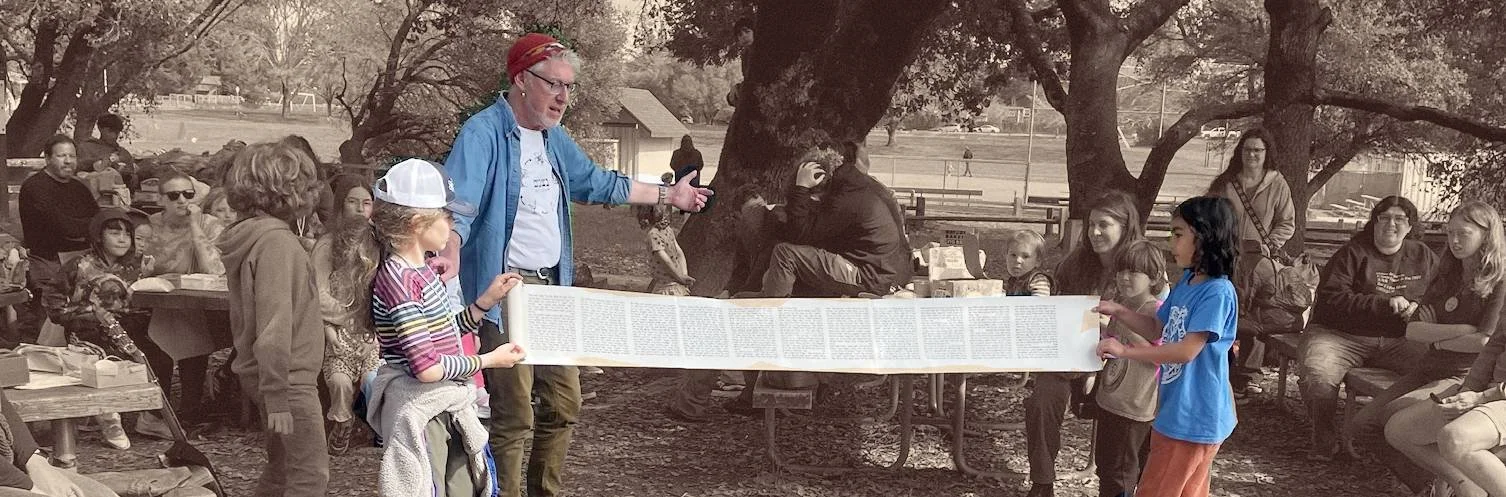
In our Nitzanim Family Learning Programs, we have over 60 families enrolled (remarkable in a synagogue our size) – over 60 families and many more ready to topple in. Families as a whole come to learn. We meet in nature, under redwoods or along rivers. We sing together and pray together and we divide up into age groups to learn Jewish values or traditions in age-appropriate ways. This is not a signal for parents to go run errands like back in your Hebrew School days. Instead, the parents meet, usually with me, on picnic benches or on the grass and we read Torah text and we talk and share and learn from each other. Those sessions are profound and are precious to me. We talk about many things, but much of it has to do with how to create a meaningful Jewish household in all our particular circumstances – in multilineage families, in busy, overextended families, in difficult times. I’ve witnessed parents begin to envision what a Shabbat practice might look like for their family. Or a sukkah in the backyard. Or a dinner conversation about some principle in Pirkei Avot. Some parents have, when their children were home sick or away on a school trip, come to Nitzanim without their children so they wouldn’t miss the parent discussion or the feel of community.
I tell you this for several reasons. One is that I’m so proud of this program that was launched in 2019 by Janet Rae Jorgensen and then grown and developed beyond any possible expectation by our hugely talented Director of Family Education, Reb Mia Zimman.
Another reason I’m telling you is that I want your participation. Some of the families that come are kids and parents. Some are kids and grandparents. And some of the people who come either to Nitzanim or to our truly fun Family Shabbat are of the older generation, and do not have little ones to use as an excuse for coming. They simply know that a Family Shabbat is certain to be rollicking and in-the-moment and filled with life. And the young families of our community begin to have real relationship with the elders of our community who show up, and that is the kind of community I want to see at Ner Shalom: intergenerational, excited, alive, and hungry for the best Judaism can offer.
And while I would not naturally go stumping on Shabbat, I will take this phrase from the Book of Malachi that we read on this Shabbat as an invitation. An invitation to invite you to turn your hearts toward the children and to experience their hearts turning toward you. We are about to launch a short fundraising campaign for Nitzanim. Many of the families and I also will be fundraising among our peers on an online platform. But we will also bring our request to you. So I ask you to watch your inbox over the next few weeks for an email about Nitzanim, asking for your support. And if you absolutely can’t wait, go to nershalom.org and click on “Youth” and there you’ll see a page for this year’s fundraising effort.
So those are some ways that you can, in the Ner Shalom community, be part of both continuity and change. The continuity of Judaism, but maybe a Judaism that our ancestors might not have been so readily able to identify.
May we be blessed to find many more ways to turn toward the ancestors and feel their love and blessing coming back toward us, and look ahead at the generations to come and feel their love and let them feel our love too.
Let’s take a moment to close our eyes and breathe. Notice where you are in your generations. Notice whatever pain or ache there is when you think about your parents. Where does that sit in your body? You can rub that spot if you’d like or breathe some air into it. Now imagine Elijah the prophet coming and turning your heart toward them and their hearts toward you. Notice the love, or imagine what it would feel like if it were just love. Take the time to feel it.
Now let’s try the other direction. Notice whatever pain or ache there is when you think about your children. Where does that sit in your body? Now imagine Elijah the prophet coming and turning your heart toward them and their hearts toward you. Notice the love, or imagine what it would feel like if it were just love. Take the time to feel it. Breathe it in.
Maybe it is easy to feel the love. Maybe it is hard to locate it. But on this Big Shabbat, this Shabbat of the Great Day, it is worth making the effort to feel it, and to follow it wherever it leads you.
