When I was 15, the US Bicentennial was in full swing. I remember that summer playing in outdoor band concerts. Those undoubtedly featured heavily American-oriented fare – marches by John Philip Sousa, the child of Portuguese and German immigrants, and surely “Appalachian Spring” or “Fanfare for the Common Man” or something symphonic by Aaron Copland, a Russian Jewish immigrant who nonetheless crafted what we all easily identify as the sound of American music.
The highlight of the summer of ‘76, though, was a road trip with my parents to Philadelphia and Washington DC. We had cousins outside of Philly we could stay with and that made it not only a Bicentennial pilgrimage but also a family trip.
At 15, I was surely aware of injustice in the world and in our country. I was certainly aware of struggles for racial, gender, and economic equality. I knew the lyrics of a range of Leftist folk songs that had reached my ears through Jewish summer camp although I might not have fully understood what they meant. Overall, though, I was still somewhat sheltered and uncritical. I believed that the struggles for justice would undoubtedly achieve a more perfect Union – and soon!
Plus, I was just plain excited about the Bicentennial. I had the soundtrack album of the musical “1776” – our generation’s “Hamilton” – and I knew every word. And so, when we arrived at Independence Hall, I was ahead of the game, with mastery over whatever historic facts had fit neatly into the play’s meter and rhyme scheme.
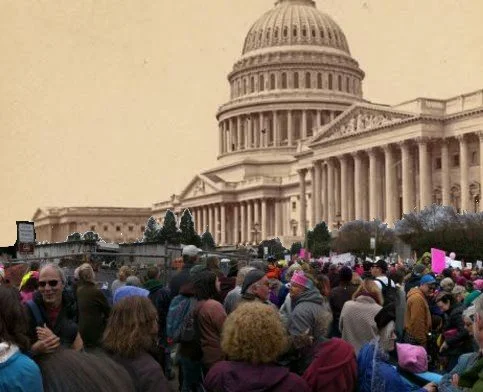
That summer might have been the most American I ever felt. Or at least, it was the most American I felt in which that identity was based in a kind of pride. Later in my life there have been times I have felt very American through acts of protest. Gay pride parades in the still-early years of gay pride parades. Street protests with ActUp. I felt American, in an angry and determined way. In fact, my first time back inside the US Capitol after the Bicentennial was 15 years later when I was arrested in the rotunda at an ActUp die-in.
I don’t know what it means in this day and age to feel American, to have “American” as an identity. Particularly in a time when the country is so divided and the Right claims ownership of so much Americanness. In this great divide that we live in, they have managed to get custody of the flag and of patriotism itself. And we on the Left are left not knowing what exactly our identity is and what symbolism is powerful and needed in this moment. Maybe we should fight for the flag and not relinquish patriotism to those who suppress protest rather than those who exercise their Constitutional right to it.
I could go on, but I want to introduce a Jewish element here. Tonight is not only Erev Fourth of July, and the eve of the 250th anniversary of the signing of the Declaration of Independence, whose “life, liberty, and pursuit of happiness” language continues to effervesce on our tongues. It is also the beginning of the three weeks of the Hebrew year that we call Beyn Hametzarim – “in the narrows.”
“The narrows” refer to the time between the breaching of the walls of Jerusalem and the destruction of the Temple, first by the Babylonians and then by the Romans. Same timetable. These three weeks recall great defeats that marked the end of our old Israelite way of life, and the beginning of Diaspora and Rabbinic Judaism as we know it. These three weeks, culminating in the mournful holiday of Tisha B’Av, are marked by contraction and contrition.
In her book, In the Narrow Places: Daily Inspiration for the Three Weeks, scholar Erica Brown quotes the Roman orator Cicero, who said, “To remain ignorant of the things that happened before you were born is to remain a child.” For her, our Jewish practice of these three weeks is indicative of a mature culture, one that considers its past and provides a schedule for working with it.
Whereas, she goes on to say, there is an immaturity, a national immaturity, when the past is ignored. And she points to the US.
Because this is what we see in America, where this Bi-and-a-half-centennial is cause for retail rather than reflection. Celebrating 250 years of this country without taking stock of the history of conquest, colonization, genocide, and slavery that enabled it to exist and survive – such a celebration is empty, unrooted in the actual experience, the full experience, of the time frame it purports to commemorate.
American culture likes to celebrate victories, and to recharacterize complex, historic moments as victories. Whereas Jewish culture, at least until recently, commemorates the terrible defeats, and that collective history and its annual retelling has bonded us together. There is danger in this too – the danger of cultivating a collective identity based in victimhood, the danger that we become unable to see ourselves as anything but victims, a tendency that has caused tremendous and fresh harm to ourselves and others.
But even with that risk of getting rooted in a narrative that doesn’t fully serve, I am proud that our tradition is to look at the past and sing, weep, retell the pain of it. What we do with that past, how we grieve, how we process, the lessons we draw from it, those are the test of who we are as individuals and as a collective. In these three weeks, it is the custom to do actual teshuvah. So this period is not just a commemoration of ancient events but a present-moment time of reckoning and accountability.
Accountability is what is most glaringly missing from the American ethos right now, from the top down. And there is nothing innocent about it. Telling the stories of slavery or of Indian massacres would now be banned from many public schools as a pet project of the woke Left, rather than a consideration of the bloody truth of this country’s history.
This semiquincentennial, or whatever it’s called, should be a mixture of celebration and trembling. Joy, tempered by an awareness of whose backs, whose sweat, whose blood built America and whose backs, whose sweat, and whose blood continues to prop it up.
We live in an empire that likes to think of itself as a small town. But I’d like to suggest that there is room for so much more than what the American ethos has shrunk to. There is room for reckoning. Reconciliation. Reparation. There is room for education. Critical thinking. Art. Poetry. There is still room for greatness.
This democracy is not dead. Not yet. Not by a longshot. It is too early to give way to hopelessness. The game isn’t over. And maybe what we need to be doing, beyond fighting for Senate seats and house seats and school board seats, beyond doing the labor of politics, is to let ourselves begin building a vision of America. What can we dream that’s bigger than electoral gains? Can we dream an America in which everyone feels that they have a voice? An America in which we hear each other even if we don’t agree? An America in which the democracy demands a kind of hippocratic oath: that even while we might debate the content of change or the speed of change, we first and foremost promise each other to do no harm? Can we dream an America where we might disagree about policy, but not about who is worthy of respect?
In this country we are right now in the narrows. It is a time for reflection and reckoning. It is a time to grieve, really grieve the harms that have been the price of this culture.
But the narrows do not go on forever. At the end of them there is an open sea and big sky. That is the expansive future that still can be. And it is up to us to participate in the visioning of that future. Populating it with principles and poetry, ideas and ideals, reckoning and celebration, Copland music, and parades with every possible kind of person in them.
We talk a lot about resistance, but resistance is not enough. We must dream. Dream the world we want. And proclaim to each other and the world what we are dreaming. Min hametzar karati Yah. From the narrow place let us call out. Anani vamerchav-Yah. And may the dreams we call out invite us into a future wide as the horizon, big as the sky.
Talk Back . . .
Use the comments section to identify something you’d like to dream into existence for America’s future. Broad principle or surprising detail. Let’s start dreaming together! (And remember: first of all, do no harm.)
